The Real Reason Your Business Doesn’t Show Up on Google Maps (And Exactly How to Fix It)
The SEO Audit Checklist Every Small Business Owner Needs in 2026 (Before You Spend Another Dollar on SEO)
What Does an SEO Agency Actually Do?
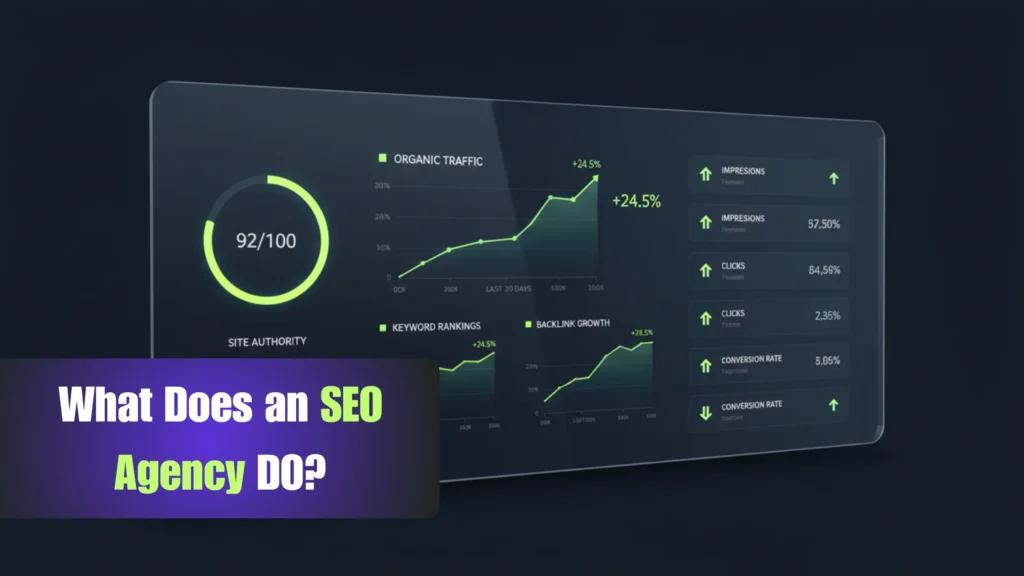
Quick answer: An SEO agency improves your website’s visibility in Google so customers already searching for what you offer find you, not your competitors. They do this through technical fixes, content optimisation, authority building, and monthly reporting tied to real business goals. The difference between a good agency and a bad one isn’t what they say they do. It’s what shows up in the report at the end of the month.
Your SEO Agency's Monthly Report Is Either a Window or a Smokescreen. Here's How to Tell the Difference.
Three months into paying for SEO, most business owners have the same conversation with themselves.
Traffic is roughly where it was. The monthly report arrived on Friday, four pages of graphs, a column of numbers, something about “domain authority,” a line about “impressions trending positively.” Everything looks fine. Nothing feels different.
Here’s the uncomfortable truth: that feeling is often correct.
Not because SEO doesn’t work. It does, consistently and compoundingly, for businesses that execute it properly. But a significant number of business owners are paying for SEO activity, not SEO results. And the reports they receive are designed, often unintentionally, sometimes deliberately, to make activity look like progress.
This post is about the difference between the two.
It breaks down exactly what a professional SEO agency should be doing every month, what that work should be producing at each stage, and what a report that proves real results looks like versus one that papers over the absence of them.
By the end, you’ll be able to sit down with your next monthly report and know, not guess, whether your investment is working.
First: what an SEO agency is actually trying to do
Before we get into reports, let’s establish the goal. Because a lot of confusion about SEO performance starts with a misunderstood brief.
An SEO agency’s job is to make your website the most relevant, trustworthy, and technically accessible result for the searches your customers are already making.
That means three simultaneous jobs:
Relevant: your pages match what people are searching for, in the way they’re searching for it. Not just the keyword. The intent behind it. Someone searching “best dental implants” is in a different mindset than someone searching “how much do dental implants cost”, and a good agency treats them as completely different content problems.
Trustworthy: Google needs enough external evidence to confidently show your site to its users. That evidence comes from other credible sites linking to you, the depth and accuracy of your content, and how consistently your business information appears across the web. This is what how Google evaluates websites comes down to at its core.
Technically accessible: Google has to be able to find, read, and index your pages without running into broken links, blocked crawlers, or load speeds that tell it your site isn’t worth prioritising.
When all three are in place and compounding, SEO becomes the highest-ROI lead channel most businesses have access to. When any one of them is missing, the whole system underperforms, and a bad report hides exactly which one is broken.
What a professional SEO agency does every month and what it should produce
Here’s where most explanations of SEO go wrong. They list the four service categories, technical, on-page, off-page, reporting, as if knowing the names tells you anything useful.
What actually matters is knowing what each category should be producing at each stage of your campaign because that’s what turns vague activity into something you can evaluate.
Technical SEO: what gets done vs what should show up in your data
Technical SEO is everything that makes your website findable and readable for Google, before a single piece of content or a single backlink is even considered.
What a professional agency actually does:
- Audits your site for crawl errors, broken links, duplicate content, slow load speeds, and mobile usability issues using Google Search Console and tools like Screaming Frog
- Monitors and fixes indexing problems, making sure your pages appear in search and aren’t accidentally blocked by a misconfigured robots.txt file
- Tracks and improves Core Web Vitals , Google’s three performance metrics measuring loading speed, visual stability, and how quickly your page responds to interaction
- Manages your XML sitemap so Google always has an accurate map of your site structure
- Sets up proper 301 redirects when pages move or are removed, so you don’t bleed authority through dead links
What this should produce in your report:
In months 1–2, your report should show a list of technical issues found and a specific record of which ones were fixed. Not “we completed a technical audit.” A numbered list: issue identified, fix implemented, status confirmed in Search Console.
By month 3 onwards, technical errors should be trending toward zero. Your Core Web Vitals should be visible, pass/fail on mobile and desktop. Your indexed pages count in Search Console should be clean and growing.
What a bad report looks like here: “Technical SEO work completed this month.” No specifics. No before/after. No confirmation that the fixes were actually implemented and verified.
What a good report looks like here: “Fixed 4 crawl errors on /services/ pages. Resolved duplicate meta description on 11 blog posts. Core Web Vitals: LCP improved from 4.2s to 2.6s on mobile. 47 pages now indexed, up from 39 last month.”
If your agency has never mentioned Core Web Vitals or shown you an indexed pages count in any report, ask for it directly in your next meeting. A proper technical SEO audit at the start of any engagement should make this the foundation of everything that follows.
On-page SEO and content: what gets done vs what should show up in your data
On-page SEO is the process of making each page on your website the best possible answer to the specific question your target customer is searching for at the moment they need you.
In 2026 this is more nuanced than title tags and keywords. Google’s algorithms evaluate topical depth, does your site cover a subject comprehensively, from multiple angles, with content that links intelligently to related pages? Or does it have a few isolated pages that each mention a keyword without building any real subject-matter authority?
What a professional agency actually does:
- Research keywords based on search intent, what does someone actually want when they type this phrase? Are they learning, comparing options, or ready to hire?
- Optimises title tags, meta descriptions, H1s, H2s, and URL structures so Google understands each page immediately
- Builds topical authority through content clusters a pillar page covering a broad topic supported by blog posts that go deep on each subtopic, all interlinked to signal expertise
- Uses schema markup so Google can display your content as rich results, FAQs, star ratings, how-to steps, which increases click-through rate even before you move up the rankings
What this should produce in your report:
In months 1–2: a keyword map showing which pages target which terms, what their current rankings are, and what the priority optimisations are.
Month 2 onwards: specific pages optimised (with before/after title tags and rankings), new content published (with target keyword and current position), and internal linking changes made.
By month 3–4: early ranking movement on long-tail keywords. These are lower-volume but highly specific searches, “SEO agency for medical tourism websites” rather than “SEO agency“, where you can rank faster and where the intent is sharper.
What a bad report looks like here: “Published 3 blog posts this month.” No keywords, no current rankings, no explanation of how they connect to your service pages.
What a good report looks like here: “Published: ‘Why Your Google Business Profile Isn’t Showing Up‘ targeting ‘GBP not showing up’ (est. 1,900/mo). Currently ranking position 31, up from not ranking. On-page optimised: /services/local-seo/ , title tag updated, 2 internal links added from new blog posts. Keyword ‘local SEO expert‘ moved from position 22 to 14.”
Off-page SEO and link building: what gets done vs what should show up in your data
Relevance gets you in the game. Authority determines where you finish.
A backlink is a link from another website to yours. Google treats these as editorial votes, evidence from the rest of the internet that your content is worth paying attention to. In 2026, one backlink from a relevant, respected publication is worth more than 100 from irrelevant directories. Volume is dead. Context and quality are everything.
What a professional agency actually does:
- Earns backlinks from relevant, authoritative websites through outreach, digital PR, and content partnerships, not paid link farms
- Runs competitor backlink gap analysis: finding sites that link to your competitors but not to you, then pursuing the same sources
- Monitors your backlink profile for toxic or spammy links that could trigger a Google penalty, and disavows them where necessary
- Builds brand mentions across trusted publications, even unlinked mentions are registered by Google as authority signals
- Manages local citations for businesses targeting local search, consistent Name, Address, Phone (NAP) across directories
What this should produce in your report:
Every month, your report should include a backlink log: which sites linked to you, the domain rating of each source, what page they linked to, and how the link was earned.
Your total referring domains count should be visible and growing. Your domain rating (in Ahrefs) or domain authority (in Moz) should trend upward over a 6–12 month window.
What a bad report looks like here: “Built 12 backlinks this month.” No sources listed. No domain authority data. No explanation of how they were acquired.
What a good report looks like here: “3 backlinks earned this month: [publication name] DA 47, linked to /blog/local-seo-guide/ from article on small business marketing. [Directory name] DA 38, local citation added, NAP consistent. [Industry blog] DA 52, guest post published, link to /services/seo-services/. Referring domains: 34 total, up from 29 last month.”
Red flag: If your agency can’t tell you specifically where your backlinks are coming from, the domain name, their relevance to your industry, or how they were earned, that’s not a minor gap. Links from the wrong places don’t just fail to help. They can actively damage your rankings.
Reporting and strategy: the section that exposes everything
This is where good agencies and bad agencies become impossible to confuse.
A good report connects every activity to a business outcome. A bad report creates the appearance of progress through activity metrics that sound meaningful but aren’t.
Here’s the side-by-side that no agency wants you to see:
REPORT A: Looks impressive, proves nothing:
Metric | This Month |
Impressions | 14,200 (+34%) |
Average Position | 18.4 |
Pages Crawled | 847 |
Domain Authority | 22 (+1) |
Backlinks Built | 12 |
Articles Published | 4 |
“Good progress this month. Impressions are up significantly, indicating improved visibility. We’ll continue executing on our content and link-building strategy.”
REPORT B — Proves what’s actually happening:
Metric | This Month | Last Month | Trend |
Organic Sessions | 1,240 | 1,050 | +18% ↑ |
Organic Leads | 11 | 7 | +57% ↑ |
Top 10 Keywords | 8 | 5 | +3 ↑ |
Commercial Keywords Moving Up | 3 | — | New |
Referring Domains | 34 | 29 | +5 ↑ |
Technical Errors | 2 | 6 | -4 ↓ |
“Organic traffic grew 18% month-over-month. 11 contact form submissions were attributed to organic search, up from 7. Three commercial keywords moved into the top 10: ‘local SEO expert [city]’ (now position 7), ‘SEO audit service’ (now position 9), ‘Google Business Profile optimisation’ (now position 6). Priority for next month: /services/seo-for-ecommerce/ currently at position 18 for ‘ecommerce SEO small business’ , optimising title, adding 3 internal links from existing posts, and targeting one backlink from a relevant ecommerce publication.”
Report A is full of activity. Report B is full of answers.
The difference isn’t data volume. It’s whether the data connects to what you actually hired the agency to do: grow the part of your business that comes from people finding you on Google.
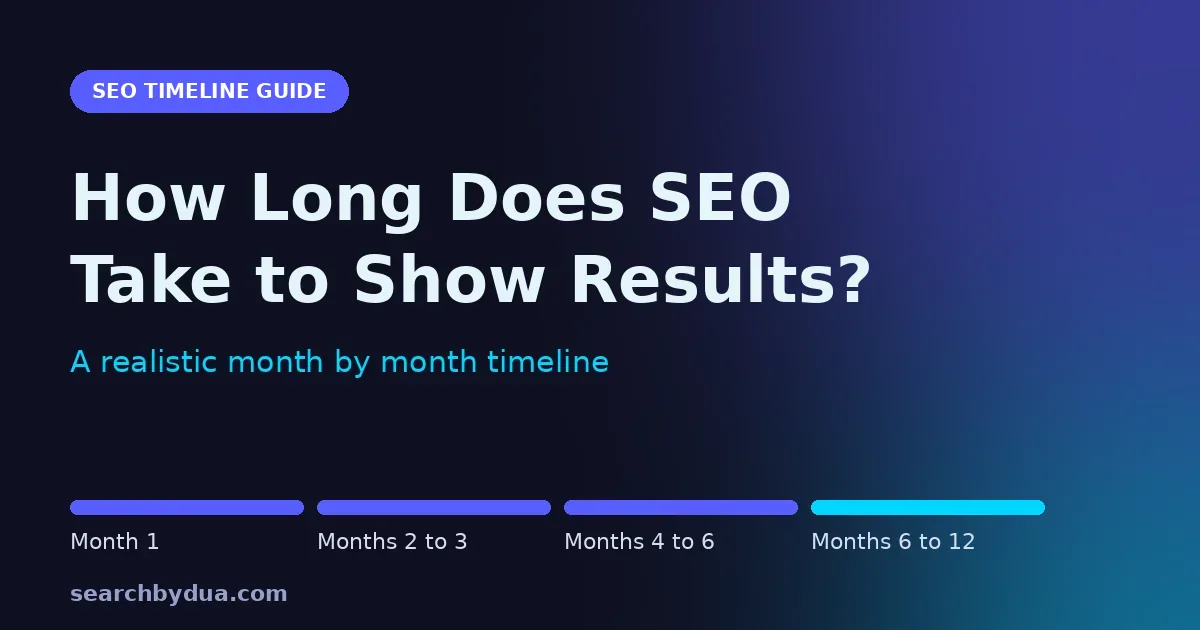
The month-by-month reality: what good SEO actually looks like over time
Here’s something almost no agency tells clients upfront, what specifically should be happening and showing in your data at each stage.
Month 1: Foundation, not rankings
You should not expect ranking movement in month 1. What you should see: a completed technical audit with specific issues documented, a keyword map showing which pages target which terms and what their baseline positions are, GA4 and Search Console set up and tracking correctly, and a 90-day roadmap with clear priorities.
If your agency is still “working on the audit” at the end of month one without any deliverables, ask for a timeline.
Month 2: First fixes, first signals
Technical issues from month 1 should be implemented and confirmed resolved. On-page optimisations on your top 3–5 service pages should be complete. You may see early movement on long-tail keywords positions improving from “not ranking” to somewhere in the 30–60 range. This is normal and encouraging.
Month 3: Traction begins
This is where our structured 3-phase SEO process starts producing visible results for most sites. Several long-tail keywords are moving into the top 20. Organic traffic is trending up, modestly, but consistently. First blog posts published as part of your content cluster. The backlink profile is growing.
Month 4–6: Compounding
Commercial keywords are moving into the top 10. Organic traffic growing 15–25%+ month-over-month for well-optimised sites. Organic leads appearing in your conversion data. This is the stage where SEO starts justifying itself in your monthly P&L, not just in the report.
Month 6–12: Authority
For competitive industries, this is when the gap between businesses with consistent SEO and those without starts becoming obvious. You’re ranking for commercial terms. Competitors are outranked on their own branded searches. Organic traffic is now your most cost-effective lead channel.
In one of our real estate SEO engagements, we took a property listings site from approximately 1,000 to 14,000 monthly organic visitors over 12 months, not through shortcuts, but through exactly this sequence executed consistently. You can read the full process in our real estate SEO case study.
Five questions to ask your SEO agency right now
Send these in an email today. The quality of the answers will tell you more than any report.
1. Can you show me your own organic traffic? An agency that sells SEO but can’t rank its own website has an obvious credibility gap. Ask to see their Search Console data or an Ahrefs overview of their own domain.
2. What specifically was done last month, task by task? “We worked on your SEO” is not an acceptable answer. You should receive a specific list: pages optimised, technical fixes implemented, content published, and backlinks earned. If they can’t produce this, the work may not happen.
3. Where is every backlink from and how was it earned? Name, domain authority, relevance to your industry, and acquisition method. If an agency is cagey about this, assume the links are low-quality or bought, both of which create ranking risk.
4. How many organic leads came from SEO last month? Traffic is not the goal. Leads are. If your agency doesn’t know this number, or doesn’t track it, that’s the first thing to fix.
5. What’s the specific plan for next month? A proactive agency arrives at your monthly call with a prioritised roadmap: here’s what we’re doing, here’s why, here’s what we expect it to produce. A reactive agency waits for you to ask what’s happening. The long-term results of these two approaches are not comparable.
What an SEO agency cannot do (honest answers)
Because managing expectations is part of doing this correctly:
❌ Guarantee rankings. No one controls Google except Google. Any agency guaranteeing first-page positions is either overpromising or using tactics that create risk you’ll pay for later.
❌ Deliver results in two weeks. Meaningful ranking movement takes 3–6 months minimum. Businesses that understand this and stay consistent win. Businesses that switch agencies every 90 days restart from zero every time.
❌ Replace your sales process. SEO brings qualified people to your website. Your offer, your pricing, and your follow-up convert them. The best SEO in the world doesn’t fix a broken sales funnel.
❌ Work in isolation. Technical SEO without content produces nothing to rank. Content without links builds no authority. Links without technical health don’t convert. It’s a system, all parts required.
Frequently asked questions
What does an SEO agency do every month? Every month, a professional SEO agency monitors rankings and traffic, implements technical fixes, optimises or publishes content aligned to your keyword map, builds backlinks through outreach and digital PR, and delivers a performance report tied to business outcomes, not just activity metrics. The balance of these activities shifts over time: early months are heavily technical; later months move toward content authority and link building.
How long does SEO take to work? Most businesses see measurable ranking improvements within 3–6 months of consistent, professional SEO work. Competitive industries or sites with significant technical problems may take 6–12 months before meaningful traffic growth is visible. Any agency promising first-page rankings in 30 days is misrepresenting what SEO delivers, or using high-risk tactics you’ll regret.
How do I know if my SEO agency is actually doing the work? Ask for a task-by-task breakdown of what was done last month, a specific backlink log with sources and domain ratings, and your organic lead count from the previous month. If any of these three requests produce a vague answer, you have your answer.
What’s the difference between SEO and just running Google Ads? Google Ads delivers immediate traffic that stops the moment you stop paying. SEO builds organic visibility that compounds over time and continues driving traffic without an ongoing cost per click. The two serve different purposes, Ads for immediate results, SEO for long-term cost-effective growth. Businesses with strong SEO typically see a significantly lower cost per lead than those relying on paid search alone.
What should I pay for SEO services? Professional SEO services range from around $500/month for focused local campaigns to $3,000–$5,000+/month for competitive national or international work. The global average monthly SEO investment is around $3,000. Services priced below $300–500/month typically rely on low-quality or automated link-building that creates ranking risk rather than sustainable growth; the savings now often become penalties later.
One last thing before you close this tab
If anything in this post made you want to pull up your last SEO report and re-read it, do that.
Look for organic leads, not just organic traffic. Look for specific backlink sources, not just a backlinks count. Look for a plan for next month with clear reasoning, not just a summary of what happened.
If the report answers those questions, you’re in good hands.
If it doesn’t, that’s worth a conversation.
We offer a free SEO analysis for businesses that want a straight answer about where their site stands and what’s actually limiting their growth. No pitch. No pressure. Just clarity.

Related posts